





























What do a brain cell and a protein found in green algae have in common? They are both parts of a discovery that has given scientists a new way to control and study the brain.
Every October, the Nobel Prize recognizes scientists, writers, and peacebuilders across the globe whose work has made an extraordinary contribution to humanity. Swedish inventor Alfred Nobel created the prizes from his fortune, wanting his money to support people who had provided the greatest benefit to humankind. The first Nobel Prize was awarded in 1901, and it continues its profound legacy as one of the highest honors a person can receive in life.
This year, the Nobel Prize in Physiology or Medicine recognizes a discovery that almost sounds so absurd to be true: using light to control neurons.
Imagine being able to turn specific brain cells on and off, like a switch, using flashes of light. That may sound like science fiction, but it is essentially what optogenetics allows scientists to do. Optogenetics is a scientific technique that uses light and genetic engineering to discover and control how the brain’s neurons move.
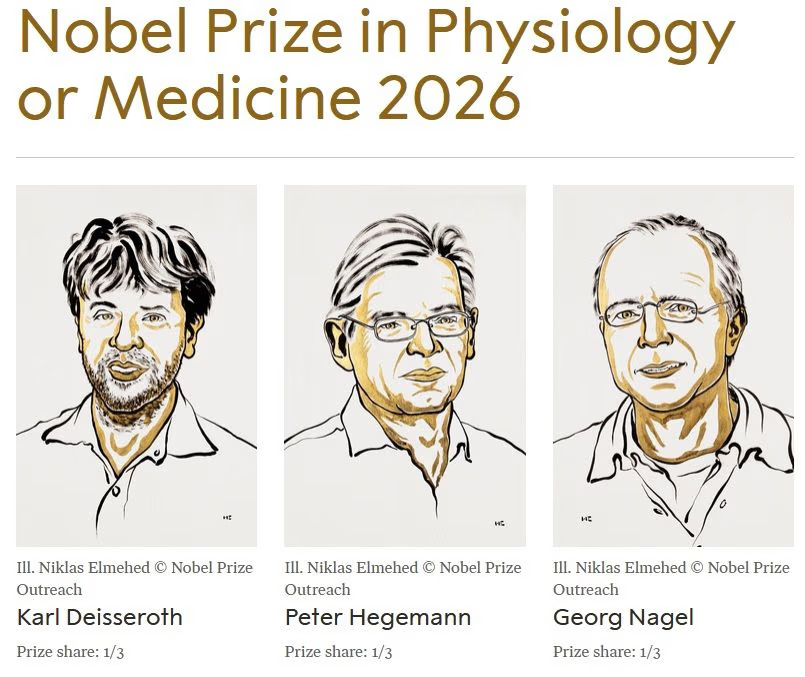
The 2026 Nobel Prize in Physiology or Medicine was awarded jointly to Karl Deisseroth, Peter Hegemann, and Georg Nagel for their discoveries of light-gated ion channels and optogenetics.
Understanding their work requires a foundation in the workings of neurons. Neurons are cells responsible for sending signals throughout the nervous system. They react with pain receptors, causing us to feel the sensation of pain. Neurons communicate with each other by moving electrically charged particles called ions across their membranes.
Hegemann and Nagel helped discover a super-protein called channelrhodopsin, found in green algae. This protein acts almost like a tiny door that opens when it receives light, allowing ions to freely flow through the cell. Deisseroth then helped build this discovery into a tool for neuroscience. They placed light-sensitive proteins into specific neurons and used flashes of light to control whether those cells became more active. In simple words, researchers found a protein that could function as a remote control for individual groups of brain cells.
Their discovery is groundbreaking. Instead of simply observing that certain brain regions are connected to memory, emotion, or behavior, scientists can manipulate specific neural circuits and study what happens. For example, if researchers want to understand how certain groups of neurons affect neurological and psychiatric disorders, they can activate or silence those neurons and observe the changes in the brain. This way, scientists can detect active neurons that directly contribute to a certain neurological action, without the need for heavy microscopic work and tedious CT scans. The biggest benefit of this discovery is that it is helping scientists investigate the mechanisms behind biological and neurological conditions at an individual, molecular level using target neurons and proteins.
A small, light-sensitive protein in algae was something that has been overlooked for centuries. Thanks to these scientists, however, the super-protein will serve as a new way to investigate the complexities of the human brain. Although optogenetics is “primarily” a research technique rather than a method of treatment for brain disorders, it shows how studying even the simplest organisms can lead to the biggest breakthroughs in understanding human biology and, potentially, creating a cure for chronic neurological diseases.
Sources:
https://www.nobelprize.org/all-nobel-prizes-2026/
https://www.nobelprize.org/uploads/2026/10/advanced-medicineprize2026.pdf
https://www.nobelprize.org/uploads/2026/10/press-medicineprize2026.pdf
Image Sources: