
















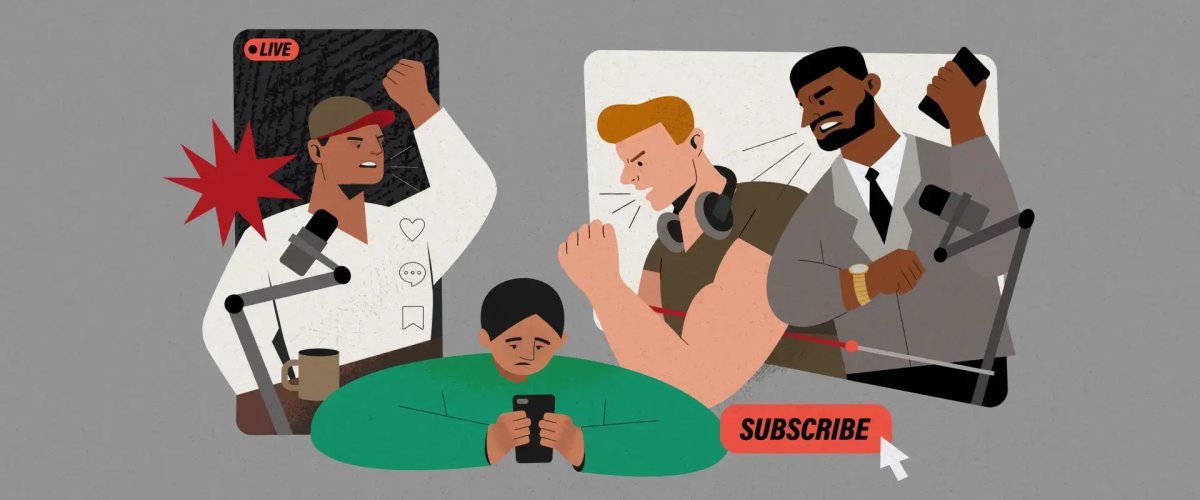








A teenage boy, struggling to fit in the school community, finds a group of successful wise men willing to give advice online. A girl sitting in middle school math class, feeling happy about getting good grades on her test, is told by her teacher to keep working hard because boys will be naturally smarter than her. Frustrated by being rejected by his crush, a man was told he may lose a lot of money chasing women but will never lose a woman by chasing money. Dreaming of working for financial corporations in Wall Street, a woman was told her natural place is in the home, and that raising kids and taking care of her man are her most important duties.
These circumstances look different, but they all come from the same place—the manosphere. The manosphere is a varied collection of websites, blogs and online forums promoting masculinity, misogyny and opposition to feminism. Typical groups include involuntary celibates (incels), who believe that they have been denied romantic and sexual experience by women and have hatred toward women; Men’s Rights Activists (MRAs), who use an academic tone to claim that modern society, influenced by feminism and women’s rights, discriminates against men and boys; and pickup artists (PUAs), who manipulate women for sexual favors. Aside from incels, MRAs, and PUAs, there are some phrases mentioned in the manosphere frequently. “Red pill ideology,” or being “red-pilled,” refers to waking up to a reality that the world favors women over men. Similarly, AWALT, or “all women are like that,” is used to stereotype women, and the term hypergamous refers to women who are obsessed with marrying “up” with men who are handsome or rich.
Women of all ages become the victims of the manosphere. Misogyny—the attitude of hostility or contempt toward women—harms them in ways that could be hidden and mild, but can also directly narrow their life choices or even manifest as violence. The example of the girl being told to keep working hard in math class due to the high possibility of being bested by boys is a manifestation of mild misogyny; the speaker subconsciously believes that boys are more talented in math and is spreading the idea that “girls are less than boys” to the girl in a hidden way. The suggestion to working women that they should devote themselves to family affects women in a very negative way because it not only denies their opportunities of working and becoming financially independent, but also distracts them from making choices freely.
Some murder cases have shown the threat of extreme misogyny. For example, in 2024, Axel Rudakubana targeted a Taylor Swift dance event, killing three young girls he saw as “vulnerable and easy prey”; that same year, Kyle Clifford murdered his ex-girlfriend, her sister, and her mother, his actions seemingly fueled by the “violent misogyny” promoted by Manosphere content creators like Andrew Tate.
These patterns of violence have also been portrayed in media. In 2025, a TV series called Adolescence centered on a thirteen-year-old boy, Jamie Miller, who is arrested after the murder of a girl in his school, raised people’s concern about the negative impact of the manosphere on teenage boys. Developmental theorists point out that the manosphere and the adolescent brain create a perfect storm because those post-puberty teenagers are in a unique brain state— searching for an identity, prone to take risks and explore unknowns, highly sensitive to perceived status, driven to be accepted and respected by peers and adult society, and primed for associative learning experiences. The algorithm also plays a role in walking young people into the manosphere, too. In fact, most boys don’t search “how to hate women.” Instead, they search for content like gym tips, how to talk with girls, or how to make money, and are then led to more extreme content.
Men who believe and spread the philosophy of the manosphere can be victims, too. Among reasons pushing a man to step into the manosphere community like social isolation, confusion about identity, economic anxiety, or dissatisfaction in romantic relationships, loneliness stands out as the biggest factor. However, teaching men to distrust women, be hyper-independent, and refuse to show vulnerability distances men from genuine communication with women and make them feel even lonelier. The idea that “seeking help is a manifestation of weakness” also reduces the possibility of receiving mental health support. Men who are told “toughness is the only acceptable response to pain” become less likely to talk with a friend or go to a therapist and then lose the chance of being healed effectively.
The manosphere ultimately destroys understanding, trust, and love between people. Undoubtedly, it is harmful to every individual in society.
Resources:
https://en.wikipedia.org/wiki/Manosphere
https://www.unwomen.org/en/articles/explainer/what-is-the-manosphere-and-why-should-we-care
https://www.generationequal.scot/news/unpacking/
https://humanrights.ca/story/online-misogyny-manosphere
https://unewsonline.com/2025/04/the-rise-of-modern-misogyny-and-the-new-manosphere/
Image resources:
https://www.unwomen.org/en/articles/explainer/what-is-the-manosphere-and-why-should-we-care