



























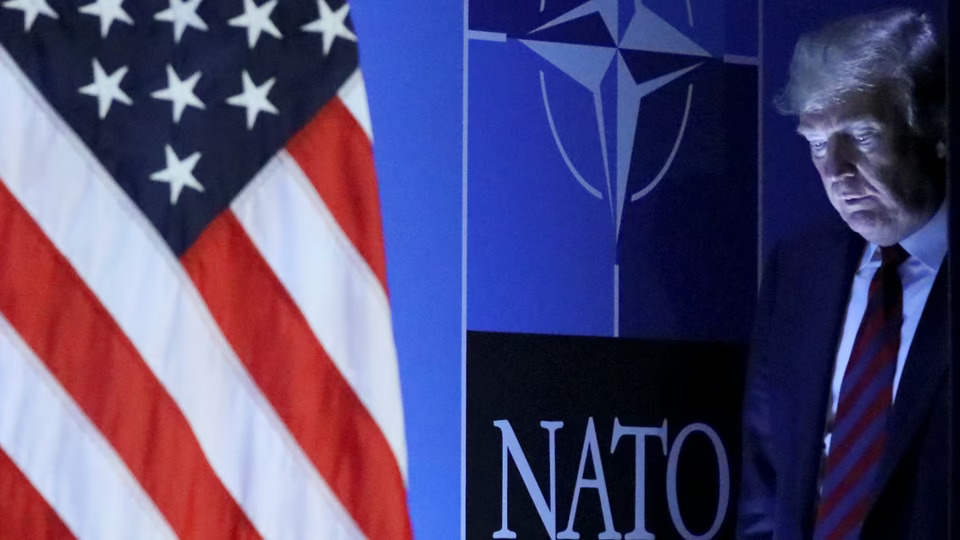
Standing firm in his belief that NATO’s member countries are not contributing enough to their own defense, President Donald Trump has repeatedly publicized his wish to withdraw from NATO. NATO (North Atlantic Treaty Organization) is a military alliance formed in 1949 to protect the U.S., Canada, and Europe, and all 32 of its member states between North America and Europe. One of NATO’s founding documents, Article 5, states that an attack on one member is an attack on all. However, throughout the recent development of the Iran War, many NATO allies have refused to support U.S. military efforts to help Israel. Despite President Trump’s partly successful attempts to increase defense spending, disagreements between primary NATO allies remain.
Trump has long criticized NATO, often calling it unfair and describing it as a “one-way street” where the U.S. does most of the work while other countries benefit. During his 2024 campaign, Trump pressured member nations to increase their defense budgets and even threatened to leave the alliance if they did not comply. Although many countries agreed to raise their spending, tensions have continued, especially during the Iran conflict. Several NATO countries have refused to allow the U.S. to use their airspace or military bases, which has made it harder for the U.S. to carry out operations. Trump has been especially frustrated that allies would not send naval support to help reopen the Strait of Hormuz, a key global trade route.
Because of these issues, Trump has recently suggested that leaving NATO is “beyond reconsideration” and has even referred to the alliance as a “paper tiger,” meaning he believes it is weak and ineffective. United States Secretary of State Marco Rubio has supported Trump’s view, saying the U.S. may need to rethink whether NATO is still beneficial. However, despite Trump’s public musings about possibly leaving the NATO alliance, it is not easy for the president to simply withdraw from a major foreign treaty. A 2023 law passed by Congress requires approval from lawmakers, specifically a two-thirds Senate majority, for the U.S. to officially be able to leave the alliance. This means that, as for now, despite Trump’s frustrations with NATO, he cannot decide on his own to take the US out of NATO without facing extreme legal challenges.
Even if the U.S. does not officially leave NATO, experts warn that Trump’s criticism and reduced involvement could weaken the alliance. Some countries are already questioning whether the U.S. would fully defend them under Article 5 if a conflict occurred. This uncertainty could damage trust between the U.S. and its allies, which is a key part of NATO’s strength. In the end, Trump’s statements may be a strategy to pressure other countries, but they also raise serious questions about the future of one of the world’s most important military alliances.
Sources:
https://www.cbsnews.com/news/trump-withdraw-nato-require-congress-approval/
https://www.democracynow.org/2026/4/10/nato_eu_trump
Image Source: